AYUSH Becomes Pillar of National Healthcare: Budget 2026 Strengthens Ayurveda Infrastructure Across India
12-Feb-26 05:38:45
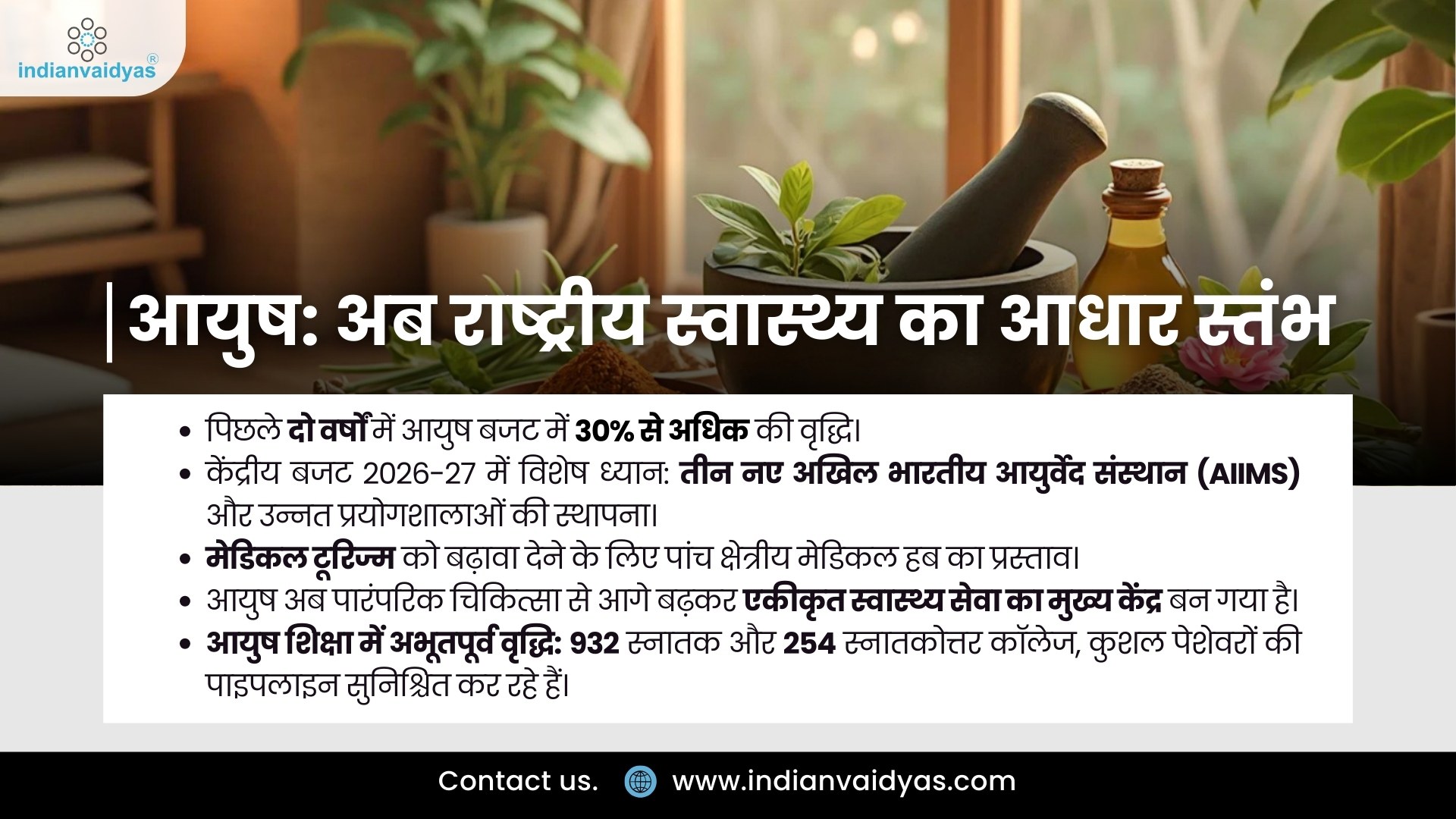
The AYUSH sector has officially emerged as a major pillar of India’s national healthcare strategy. In the Union Budget 2026–27, the government has significantly expanded its focus on Ayurveda and traditional medicine systems, marking a structural shift in how India views integrative healthcare.
According to recent budget announcements, the AYUSH allocation has increased by more than 30 percent over the past two years. This growth signals a clear policy direction: Ayurveda is no longer positioned as a supplementary system but as a core contributor to India’s healthcare infrastructure.
Three New All India Institutes of Ayurveda Announced
One of the most impactful announcements includes the establishment of three new All India Institutes of Ayurveda. These institutions are expected to function as centres of excellence, similar in structure and vision to AIIMS in modern medicine.
The objective is to:
- Strengthen advanced Ayurvedic education
- Expand research in classical and evidence-based Ayurveda
- Improve clinical training standards
- Build international credibility for Indian Vaidyas
This move will significantly enhance opportunities for Vaidyas in India, particularly in academic, research, and institutional practice roles.
Strengthening AYUSH Laboratories and Pharmacies
The government has also proposed upgrades to AYUSH pharmacies and advanced testing laboratories. These upgrades are aimed at:
- Improving medicine certification standards
- Enhancing quality control
- Strengthening export readiness
- Ensuring global compliance standards
This development supports India’s ambition to position Ayurveda as a credible global health export.
Boost to Medical Tourism Through Regional Hubs
To promote medical tourism, the proposal includes the creation of five regional medical hubs. These hubs are expected to:
- Attract international patients seeking Ayurvedic treatment
- Standardise clinical protocols
- Promote integrative healthcare services
- Increase global visibility of Indian Vaidyas
- India’s traditional healing systems are increasingly being recognised internationally, and this structured investment will likely accelerate that trend.
Major Growth in Ayurveda Education
The AYUSH education ecosystem has seen remarkable expansion. Currently:
- 932 undergraduate Ayurvedic colleges
- 254 postgraduate institutions
These institutions are producing skilled practitioners and strengthening the professional pipeline for Vaidyas in India.
The expansion ensures that the growing demand for Ayurvedic doctors across Delhi, Mumbai, Hyderabad, Bengaluru, and other cities can be met with qualified professionals.
AYUSH as a National Health Strategy
The shift in policy clearly shows that AYUSH is now being integrated into mainstream healthcare planning. The focus is not only on traditional practice but on:
- Evidence-based clinical integration
- Research-backed protocols
- Regulatory strengthening
- Education reform
- Global positioning
This structural expansion strengthens India’s position as the birthplace and global hub of Ayurveda.
Impact on Vaidyas in India
For practising Vaidyas, this budget expansion means:
- Increased institutional opportunities
- More academic and research roles
- Stronger regulatory support
- Improved public trust
- Better infrastructure for clinical practice
For patients, it means greater access to structured, standardised, and certified Ayurvedic healthcare.
Conclusion
With consistent budget increases, new All India Institutes of Ayurveda, laboratory upgrades, and educational expansion, AYUSH is firmly establishing itself as a foundation of India’s national health strategy.
This marks a transformative phase not just for Ayurveda but for the entire ecosystem of Vaidyas in India.
Indianvaidyas will continue to track and report developments shaping the future of Ayurveda and Ayurvedic doctors across India.