Ayush Treatment Goes Global: India Strengthens Traditional Medicine Presence in 43 Countries
20-Dec-25 03:57:21
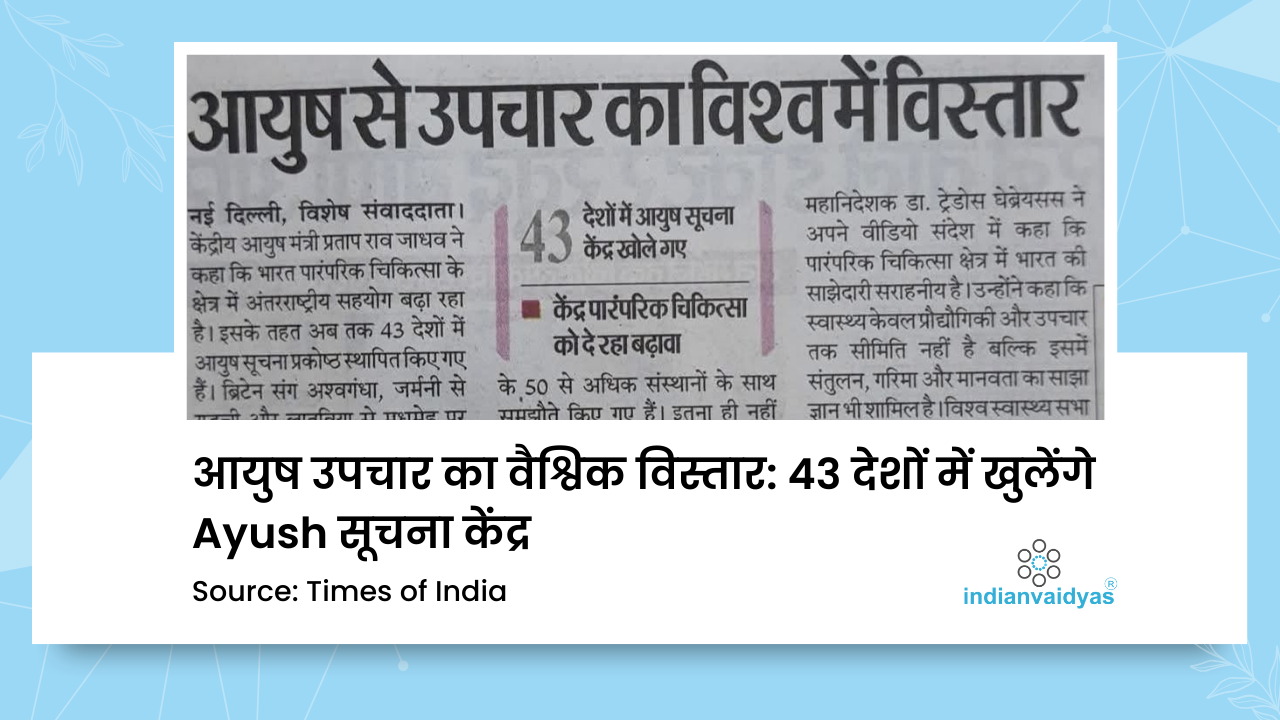
Ayush Treatment Goes Global: India Strengthens Traditional Medicine Presence in 43 Countries
India’s traditional systems of medicine are no longer confined to its own borders. Under the Ayush ministry’s international cooperation efforts, Ayush-based treatment is rapidly expanding across the world, with India now supporting Ayush information and collaboration structures in dozens of countries.
Recent statements by the Minister of Ayush highlight that Ayush Information Cells have been established in 43 locations across nearly 39 countries, along with Ayush academic chairs and institutional collaborations. India Brand Equity Foundation. These hubs act as knowledge windows into Ayurveda, Yoga, Unani, Siddha, Sowa Rigpa and Homoeopathy, providing authentic information and connecting local institutions with Indian experts.
From national heritage to global network
For decades, Ayurveda and other Ayush systems were seen mainly as India’s cultural heritage. That perception is changing fast. Over the last ten years, the Ministry of Ayush has:
-
Signed more than twenty five country level Memoranda of Understanding for cooperation in traditional medicine
-
Built over fifty institution to institution partnerships for research and education
-
Set up around fifteen Ayush academic chairs in foreign universities
-
Created Ayush Information Cells in 43 locations across the world
These figures show that Ayush has become one of the most internationally engaged sectors in Indian governance, helping India project soft power rooted in health knowledge and preventive care. India Brand Equity Foundation
The Information Cells typically operate from embassies, cultural centres, universities or partnered institutes. They host awareness events, support International Day of Yoga, Ayurveda Day celebrations and continuing education programmes, while also guiding local stakeholders on training, research and products.
WHO partnership and the Jamnagar centre
India’s ambitions are strengthened by its deepening partnership with the World Health Organisation on traditional medicine. The country already hosts the WHO Global Centre for Traditional Medicine in Jamnagar, Gujarat, which is being developed as a reference point for evidence, standards and digital documentation of traditional medicine practices. The Week
Under this partnership, key milestones include:
-
Integration of Ayurveda, Siddha and Unani morbidity codes into the ICD 11 classification
-
Ongoing development of the International Classification of Health Interventions module for traditional medicine
-
A donor agreement that outlines long term support for the Jamnagar centre’s work on research, regulation and capacity building
These steps aim to give traditional medicine the same language, coding and documentation framework that modern biomedicine uses, which is essential for large scale research and health system integration.
2nd WHO Global Summit on Traditional Medicine in India
The global spotlight on Ayush is further sharpened by India’s role as host of the 2nd WHO Global Summit on Traditional Medicine, being held at Bharat Mandapam in New Delhi. Experts and delegates from more than one hundred countries are expected to participate.The Times of India
The summit builds on the first WHO traditional medicine summit and the Gujarat Declaration, reaffirming a shared commitment to science based, sustainable and equitable traditional medicine. The discussions focus on:
-
Evidence generation and clinical documentation
-
Digital health, artificial intelligence and big data for traditional medicine
-
Regulation, quality and safety of herbal products
-
Integrative models that combine Ayush and modern medicine in primary healthcare
For India, hosting this summit reinforces its position as a natural convening power in global traditional medicine.
Education, research and digital innovation
Internationalisation is not limited to diplomatic events. The Ayush ministry has steadily expanded education and research pathways for foreign nationals. India offers over one hundred scholarships each year to students from other countries who want to study Ayurveda, Yoga and related disciplines in Indian institutions.www.ndtv.com
At the same time, collaborative research projects are underway with universities and hospitals in the United Kingdom, Germany, Latvia and several other countries, covering topics such as:
-
Ashwagandha for stress and sleep
-
Guduchi based formulations for immunity and infections
-
Ayurveda led approaches to diabetes and metabolic health
Digital initiatives like Ayush Grid, telemedicine platforms and AI assisted research portals are being used to document large datasets from clinical practice and to support remote consultations.www.ndtv.com
What this means for patients and practitioners
For global patients, this expanding network of Ayush Information Cells, academic chairs, WHO centres and research partnerships means that traditional medicine from India is becoming more:
-
Accessible, with more clinics, teleconsultation options and certified practitioners
-
Evidence based, thanks to structured trials, documentation and coding systems
-
Regulated and safer, with increasing emphasis on quality control and pharmacovigilance
-
Integrated, as more health systems explore combining Ayush therapies with conventional care, especially for chronic lifestyle conditions
For Indian practitioners, the shift creates new opportunities in teaching, collaborative research and cross border practice, while also demanding higher standards of documentation and outcomes reporting.
Ayuquo Centrum: linking global Ayush policy with on ground care
Policies and MoUs only create impact when patients experience better care in clinics and hospitals. This is where doctor led centres such as Ayuquo Centrum in Noida become important examples.
Ayuquo Centrum positions itself as a specialised Ayurvedic and integrative care centre focused on evidence informed protocols, outcome tracking and patient centric experience. By adopting strong clinical documentation, second opinion support and technology enabled follow up systems, such centres can connect directly with the vision that WHO and the Ministry of Ayush are articulating for the next decade.
In the context of global Ayush expansion, centres like Ayuquo Centrum can:
-
Serve as referral hubs for international patients seeking trusted Ayurvedic care in India
-
Participate in collaborative registries and practice based research networks
-
Train practitioners and interns from partner countries who come through Ayush scholarships or MoUs
-
Demonstrate models of integrative care that are replicable in other geographies
As Ayush Information Cells around the world respond to growing local interest, they need credible, outcomes driven partners in India for referrals, training and product validation. Ayuquo Centrum and similar doctor led setups are natural candidates for this role.
The road ahead for Ayush as a global health partner
Despite the rapid expansion, experts point out that the journey is far from complete. Regulatory harmonisation, robust safety monitoring, transparent communication of benefits and risks, and high quality clinical trials remain ongoing priorities.Frontiers
However, the combination of:
-
A structured network of Ayush Information Cells in 43 countries
-
WHO backed initiatives such as the Jamnagar Global Traditional Medicine Centre
-
Regular global summits and international MoUs
-
Digital and AI-based platforms for documentation
shows that traditional medicine from India is moving decisively from the margins into the mainstream of global health discussions.
For IndianVaidyas, this moment is both an opportunity and a responsibility. As a platform committed to doctor-led Ayurveda and integrative care, we will continue to track how these international developments translate into better patient outcomes, stronger clinical standards and genuine wellness gains for people in India and abroad.
Doctor-led institutions like Ayuquo Centrum: Ayurvedic Hospital in Noida, India, will be key partners in ensuring that the promise of Ayush in 43 countries is not only a diplomatic success, but a genuine transformation in how the world experiences traditional medicine.
Source Box
Sources:
-
Ministry of Ayush and IBEF briefs on international cooperation, MoUs, Ayush Chairs and 43 Ayush Information Cells in 39 countries. India Brand Equity Foundation
-
WHO partnership updates and remarks by the Ayush Minister on scholarships, research collaborations and the Jamnagar Global Traditional Medicine Centre. The Week
-
Reports on the 2nd WHO Global Summit on Traditional Medicine hosted in New Delhi. The Times of India
-
Peer reviewed analysis of India’s Ayush outreach and integration into primary healthcare. Frontiers