Global Healthcare Convergence: BRICS Backs Expert Working Group on Traditional Medicine in Landmark Declaration
17-Sep-26 12:02:25
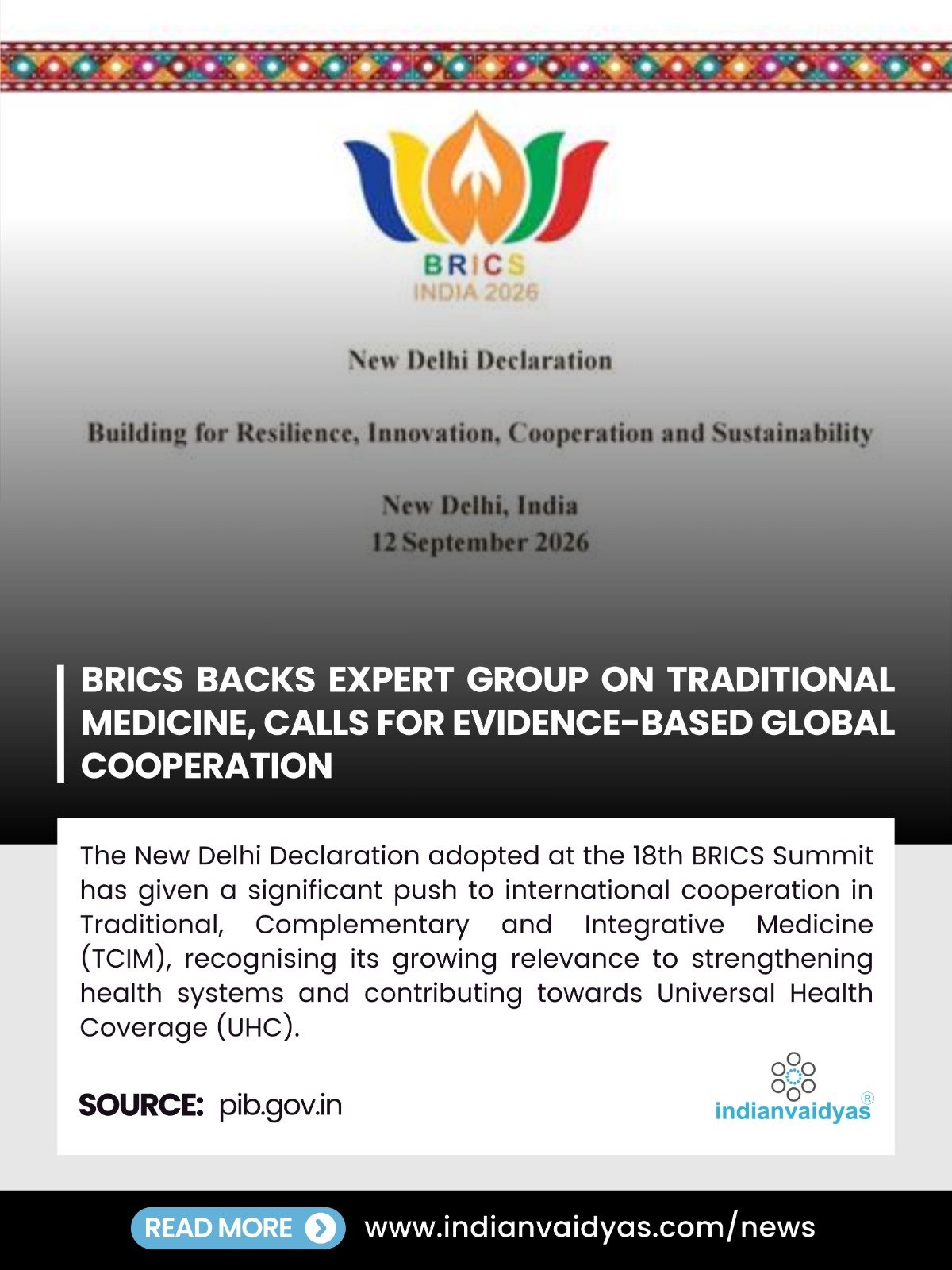
In a major milestone for global healthcare collaboration, member nations of the BRICS block have formally backed the creation of an Expert Working Group on Traditional, Complementary, and Integrative Medicine (TCIM) under the newly adopted New Delhi Declaration.
The declaration acknowledges the growing global demand for integrative health models, calling for structured research, quality harmonization, and knowledge sharing across member states. The initiative aims to leverage the rich traditional pharmacopoeias of BRICS countries to develop safe, effective, and affordable therapeutic products.
Bridging Traditional Wisdom and Evidence-Based Science
Highlighting the significance of the New Delhi Declaration, Union Minister of State (Independent Charge) for Ayush, Prataprao Jadhav, emphasized that international recognition of traditional medicine systems is a crucial step toward building resilient global public health frameworks.
"The recognition of Traditional, Complementary, and Integrative Medicine in the New Delhi Declaration is an important step towards strengthening global cooperation in health," stated Minister Jadhav. "The proposed BRICS Expert Working Group will provide a meaningful platform for Member States to share knowledge, strengthen research, and advance evidence-based approaches."
Speaking on the operational roadmap, Vaidya Rajesh Kotecha, Secretary, Ministry of Ayush, noted that India’s robust Ayush research ecosystem is fully prepared to drive collaborative efforts. The Secretary affirmed that the Expert Working Group will prioritize:
-
Collaborative Research Protocols: Conducting joint clinical trials, pharmacological studies, and observational safety audits.
-
Quality & Regulatory Alignment: Establishing standardized quality controls for herbal formulations and medicinal plant raw materials.
-
Medicinal Plant Conservation: Facilitating joint research on indigenous medicinal flora used for both preventive health and therapeutic intervention.
Global Implications for Ayush Practice and Education
The establishment of a dedicated BRICS working group marks a significant transition from bilateral agreements toward multilateral governance in traditional healthcare.
By creating a unified framework for evidence generation, the initiative directly complements ongoing developments in Ayurveda education, where academic institutions are expanding interdisciplinary research, pharmacovigilance, and standardized clinical methodologies.
Stay tuned to our Ayurveda News hub for ongoing international updates, policy developments, and global research announcements across the Ayush sector.