Strategic Elevation: India and Uzbekistan Upgrade Relations to a Comprehensive Strategic Partnership
31-Aug-26 07:03:37
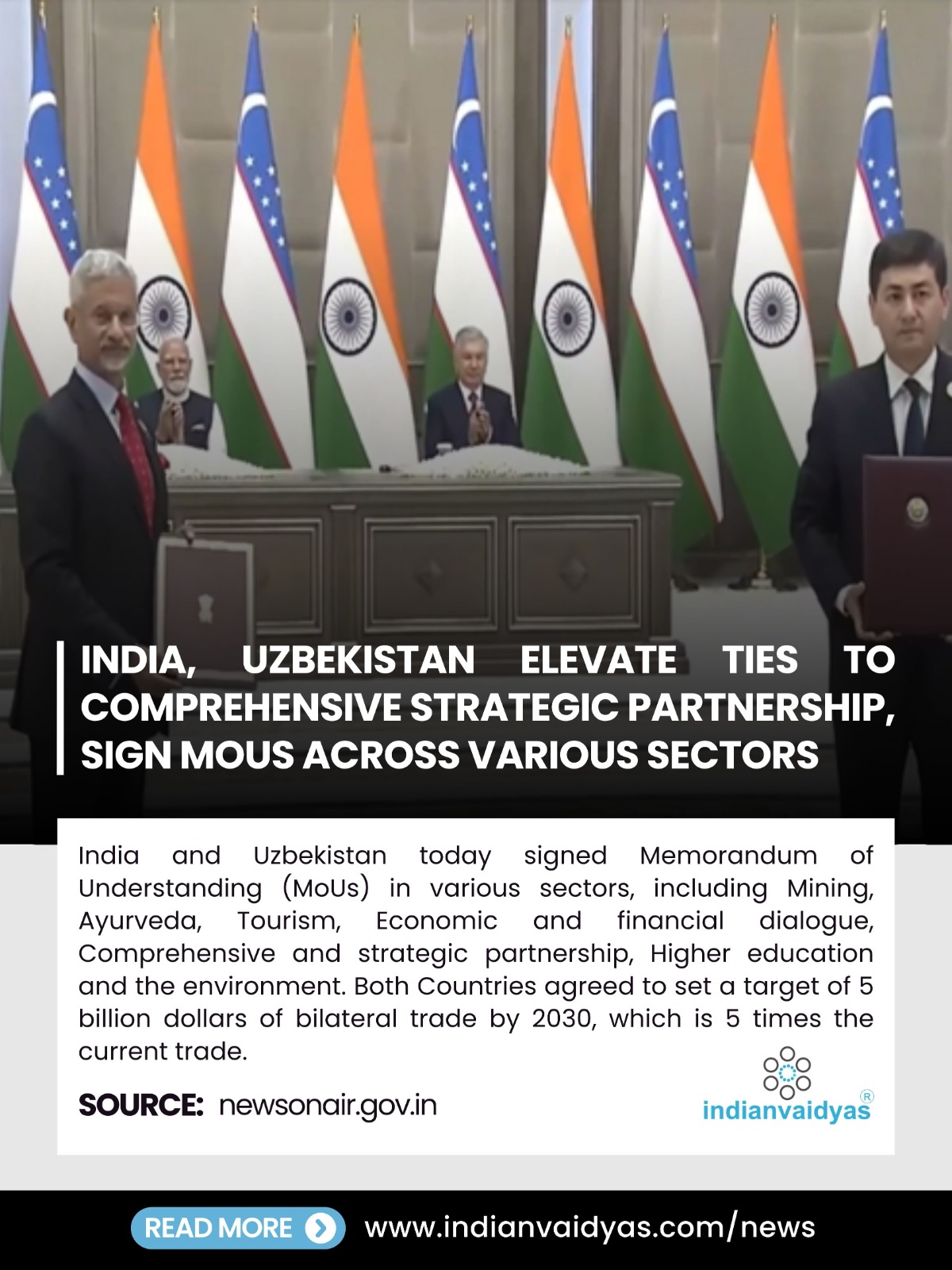
In a major geopolitical milestone strengthening ties with Central Asia, Prime Minister Narendra Modi and Uzbek President Shavkat Mirziyoyev agreed to elevate bilateral relations between India and Uzbekistan to a Comprehensive Strategic Partnership.
The announcement followed delegation-level talks in Tashkent, where both leaders reviewed the entire spectrum of bilateral cooperation. The expanded partnership places strong emphasis on trade expansion, digital public infrastructure, regional connectivity via transit corridors, and institutional exchanges in traditional systems of medicine.
Key Pillars of the Bilateral Framework
During the high-level summit, both nations reached consensus across several core areas aimed at accelerating economic and strategic cooperation:
-
Trade & Investment Acceleration: Setting an ambitious target to scale bilateral trade to $5 billion by 2030, driven by diversified trade pathways, critical mineral exploration, and manufacturing partnerships.
-
Digital Connectivity & Financial Integration: Progressing on the integration of digital payment interfaces (linking India’s UPI ecosystem with Uzbekistan's national payment architecture) to facilitate seamless business transactions, tourism, and financial services.
-
Regional Transit Corridors: Reaffirming commitment to utilizing the Chabahar Port in Iran and the International North-South Transport Corridor (INSTC) to enhance direct maritime and land connectivity between India and Central Asian economies.
-
Cooperation in Traditional Medicine: Deepening institutional collaborations between research academies, regulatory boards, and clinical bodies in Ayurveda and alternative healthcare systems.
Promoting Institutional Exchanges in Healthcare
Prime Minister Modi noted that the upgraded partnership creates a structured roadmap to align national development goals while strengthening cultural and scientific linkages between both historical societies.
The emphasis on traditional medicine reflects growing global interest in integrative health systems. Institutional frameworks signed between both nations facilitate structured academic exchanges, standardizing quality parameters for herbal products, and encouraging joint research initiatives aligned with guidelines set by the Ministry of Ayush
These institutional channels offer vast opportunities for scholars and clinical practitioners in Ayurveda education, paving the way for joint international studies, faculty exchanges, and cross-border clinical research.
Stay tuned to our Ayurveda News hub for ongoing international updates, policy developments, and global healthcare partnerships.