The Dawn of Pluralistic Medicine: Why Agnikarma and Robotic Surgery Are Sharing the Same Stage in India
17-Jul-26 10:35:44
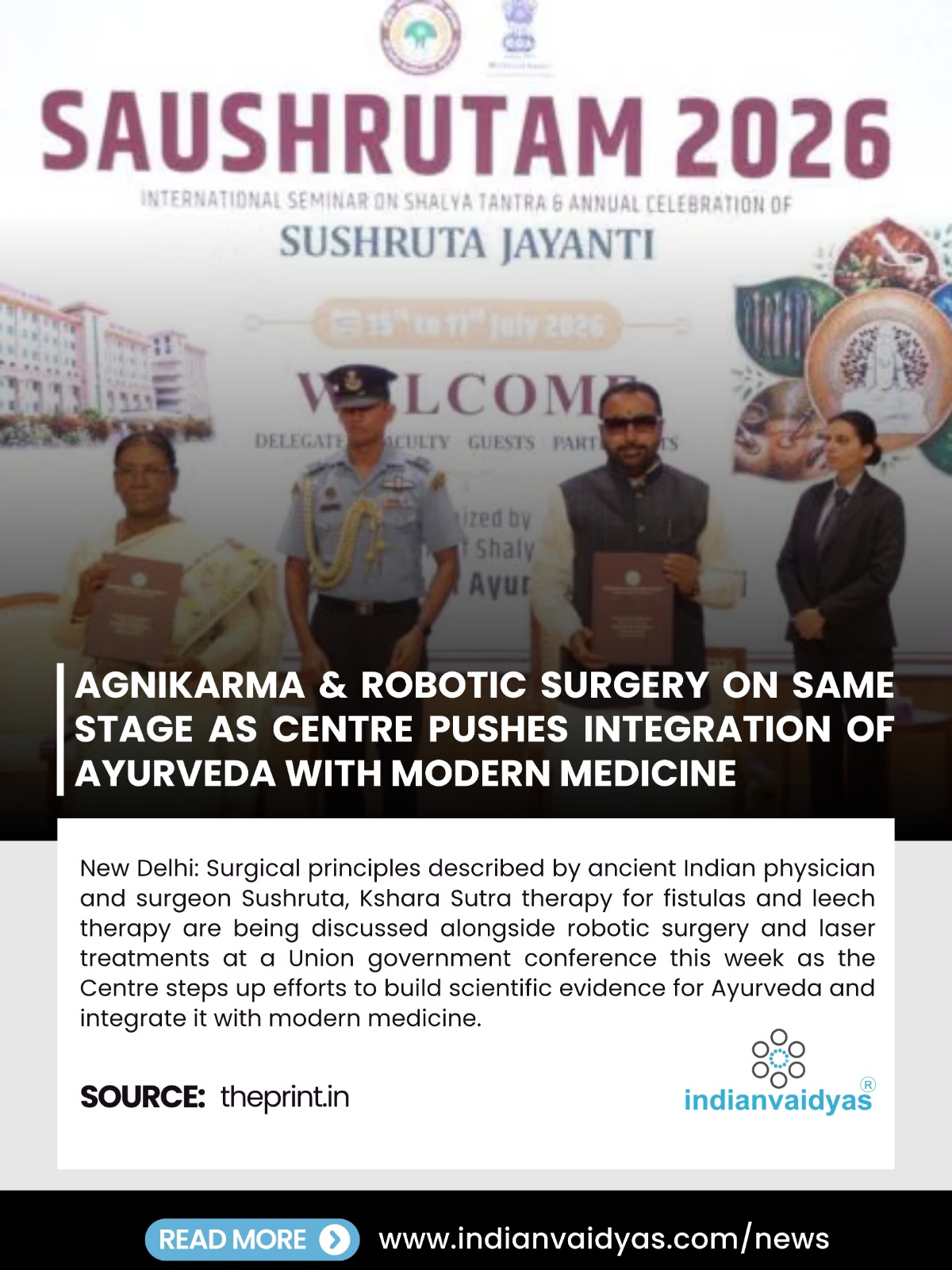
The Dawn of Pluralistic Medicine: Why Agnikarma and Robotic Surgery Are Sharing the Same Stage in India
For generations, the Indian healthcare system has operated in rigid, isolated silos. A patient either chose the clinical precision of modern allopathy or the holistic healing of traditional Indian medicine. Today, that divide is aggressively dissolving. In an unprecedented evolutionary leap for global healthcare, ancient thermal micro-cauterization (Agnikarma) and cutting-edge robotic surgery are now sharing the same global stage.
Driven by a decisive policy push from the central government, India is aggressively pursuing the integration of Ayurveda with modern medicine. This is not a superficial blend of therapies; it is a highly structured, evidence-based effort to build a symbiotic healthcare model where traditional wisdom and modern technological breakthroughs work side-by-side to improve patient outcomes.
Breaking Down Medical Silos
The current cross-disciplinary framework is completely reimagining the boundaries of Shalya Tantra (Ayurvedic surgery) and modern operative care. Top medical minds from premier institutions like AIIMS and the All India Institute of Ayurveda (AIIA) are moving away from professional skepticism and moving toward genuine collaboration.
This clinical handshake is manifesting in several profound ways. Instead of competing, doctors are building co-managed clinical protocols. For instance, complex anorectal and musculoskeletal conditions are being mapped out so that targeted Ayurvedic procedures—like Kshara Sutra and Agnikarma—are backed by advanced modern pre-operative diagnostics. By deploying high-end, AI-enabled tools like 3 Tesla MRI systems within specialized Ayush centers, clinicians can now track and visually validate the precise tissue-regeneration impact of traditional therapies.
This real-world integration is rapidly trickling down to reshape modern Ayurveda education. The next generation of medical research scholars is being trained to navigate both classical Sanskrit texts and modern surgical environments with equal fluency, giving rise to a highly versatile medical workforce.
The Pursuit of Global Scientific Validation
The ultimate goal of placing a centuries-old thermal procedure on the same platform as a multi-million dollar surgical robot is validation. By standardizing these integrated workflows and measuring real-time recovery data through rigorous, multi-center clinical trials, India aims to present the global medical community with undeniable scientific proof.
From a practical standpoint, the combination makes perfect sense. While a surgical robot offers unmatched geometric precision for deep internal resections, localized Ayurvedic procedures like Agnikarma provide non-invasive, incredibly cost-efficient alternatives for managing chronic pain, reducing inflammation, and stimulating localized cellular repair. When these two systems are strategically paired, the result is a deeply comprehensive, affordable, and far less traumatic recovery journey for the patient.
Key administrative voices and representatives from the Ministry of Ayush have repeatedly stressed that this movement is not about diluting the purity of either medical science. Instead, it is a conscious effort to harvest the absolute best components of both fields to build a genuinely patient-centric universe.
As these collaborative treatments continue to prove their efficacy on the hospital floor, they are fundamentally altering the landscape of Ayurveda News —pivoting the sector away from general wellness trends and steering it directly into mainstream clinical milestones.