WHO Begins Global Coding of Ayurveda, Siddha and Unani Interventions, Paving Way for Mainstream Integration
28-Dec-25 04:10:18
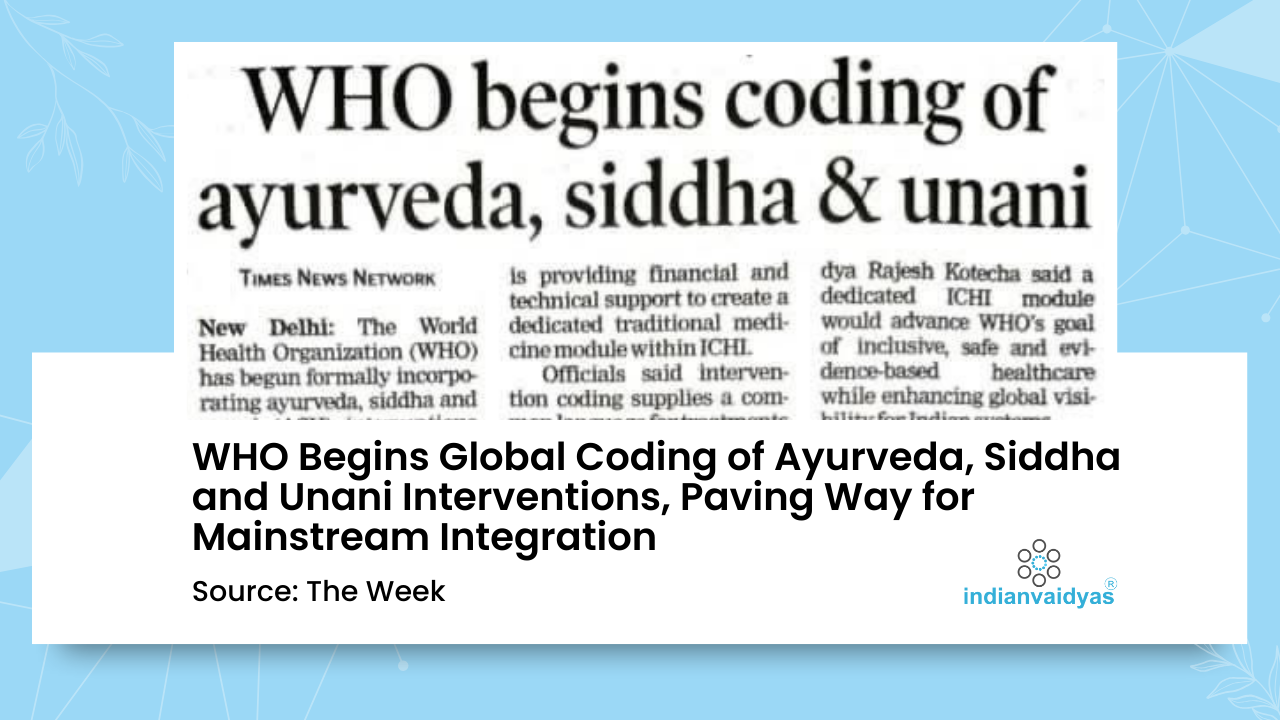
The World Health Organization (WHO) has begun formally incorporating Ayurveda, Siddha and Unani (ASU) interventions into the International Classification of Health Interventions (ICHI), the global standard used to record and compare healthcare procedures. This marks one of the most important steps so far towards bringing India’s traditional medicine systems into the global healthcare mainstream. The Times of India
From MoU to global coding
Momentum for this move has been building through 2024 and 2025. In May 2025, the Ministry of Ayush and WHO signed a Memorandum of Understanding and donor agreement under which India committed financial and technical support to help create a dedicated Traditional Medicine module within ICHI.The Times of India
Building on this agreement, WHO organised a two-day technical project meeting in New Delhi in December to work on intervention code sets for traditional medicine. The sessions were chaired by Kavita Garg, Joint Secretary at the Ministry of Ayush, and brought together:
-
Heads of India’s three central research councils – CCRAS (Ayurveda), CCRS (Siddha) and CCRUM (Unani)
-
Classification experts from WHO headquarters in Geneva
-
Specialists from the WHO Global Centre for Traditional Medicine in Jamnagar
-
Representatives from WHO’s South-East Asia Regional Office and delegates from all six WHO regions, including countries such as Bhutan, Brazil, Iran, Malaysia, Nepal, Mauritius, South Africa, Sri Lanka, the Philippines, the UK and the US. The Times of India
The outcome of this process is the decision to start formally coding ASU interventions within ICHI.
What is ICHI and why does coding matter?
ICHI sits alongside the better-known International Classification of Diseases (ICD-11). While ICD-11 classifies diseases and health conditions, ICHI classifies the interventions that health systems actually deliver – from surgeries and diagnostic procedures to rehabilitation and now, traditional medicine therapies.The Week
By developing an ICHI module for traditional medicine, WHO is creating a common language for documenting Ayurvedic, Siddha and Unani procedures such as:
-
Panchakarma therapies
-
Yoga-based therapeutic interventions
-
Unani regimens and procedures
-
Siddha external and internal therapies The Economic Times
Once coded, these interventions can be:
-
Recorded in hospital and clinic information systems
-
Analysed and compared across regions and countries
-
Included more easily in insurance and reimbursement frameworks
-
Used in large-scale health services and outcomes research
In simple terms, what was previously “invisible” in global data will now be systematically captured.
Mainstreaming ASU in global health
Ayush Secretary Vaidya Rajesh Kotecha has described the new ICHI module as a key tool for giving Ayush systems scientific credibility and global visibility. By enabling dual coding with ICD-11 and ICHI, health systems will be able to see which traditional interventions are being used, for which conditions, and with what outcomes.Bureaucrats India+2Bureaucrats India+2
According to the Ayush Ministry and WHO statements, the benefits of this initiative include:
-
Standardisation and transparency – therapies are described using consistent, internationally recognised terminology.
-
Better billing and pricing – hospitals and clinics can map ASU services to structured codes, supporting fair pricing and easier integration with health insurance. The Economic Times
-
Improved clinical documentation – practitioners can record interventions in a way that is interoperable with modern medical records.
-
Stronger research base – coded data supports health services research, outcomes tracking and evidence-based policy making.
WHO has emphasised that this work aligns with its goal of inclusive, safe and evidence-based healthcare, where traditional and modern systems can be documented and assessed using comparable metrics.The Times of India
A milestone for Ayurveda, Siddha and Unani
For Ayurveda, Siddha and Unani, the shift from narrative descriptions to structured coding is historically significant:
-
It moves these systems from the periphery of anecdotal practice into the space of formal health governance and statistics.
-
It allows governments to see how widely ASU interventions are used, where they are working well, and where quality or safety issues need attention.
-
It supports the design of integrative health models, where ASU therapies can be combined with conventional care based on documented patterns rather than guesswork.
This development also complements earlier milestones like the ICD-11 TM modules, which created a dedicated classification space for traditional medicine conditions, and the establishment of the WHO Global Centre for Traditional Medicine in Jamnagar, supported by India.Bureaucrats India+2Bureaucrats India+2
What it means for practitioners and patients
For practitioners of Ayurveda, Siddha and Unani:
-
There will be increasing expectations to use standard codes in their documentation, especially in larger hospitals, Ayush teaching institutions and integrative care centres.
-
Participation in insurance-linked services and public health programmes will become easier where coded interventions are a requirement.
-
Access to multi-country data through WHO platforms will open new opportunities for collaborative research and benchmarking.
For patients:
-
Over time, they may see Ayush services more clearly listed in hospital bills, insurance policies and health records.
-
Policy makers will be better placed to evaluate where traditional medicine adds value – for example in chronic disease management, rehabilitation and preventive care – and to design programmes accordingly.
-
The combination of ICD-11 and ICHI data will help ensure that decisions about traditional therapies are based on real-world evidence, not only tradition or marketing.
Indianvaidyas’ perspective
For platforms like Indianvaidyas, which aim to connect patients with genuine, doctor-led Ayurvedic care, WHO’s coding initiative is an important step. It signals that the global conversation on health is shifting from “whether” traditional medicine should be recognised to “how” it can be documented, regulated and integrated responsibly.
As WHO and the Ministry of Ayush roll out the ICHI traditional medicine module, Indianvaidyas will continue to track how coding is implemented in clinics and hospitals, what it means for practising Vaidyas and Hakims, and how patients can benefit from a more transparent, data-driven approach to Ayurveda, Siddha and Unani.